
OpenFret Logo
NewLessons now play in your tuning, and read three waysGuitar Quest

Plug in. Play notes.
Slay monsters.

Learn the fretboard through gameplay. With your real guitar or bass.

Try the demo

$30 once. No subscription. Both instruments, and every update after it.

14

guitar tunings your lessons follow you into

3

ways to read every chart

0

of your own files uploaded, ever

1

payment, and then never again

Setup in seconds

PLUGINYOURguitar or bassTOYOURAUDIOINTERFACEANDSTARTPLAYING.

Acoustic? Built-in mic works.
Electric? USB interface recommended.
Bass? Yes, it's supported.
No download. No signup.

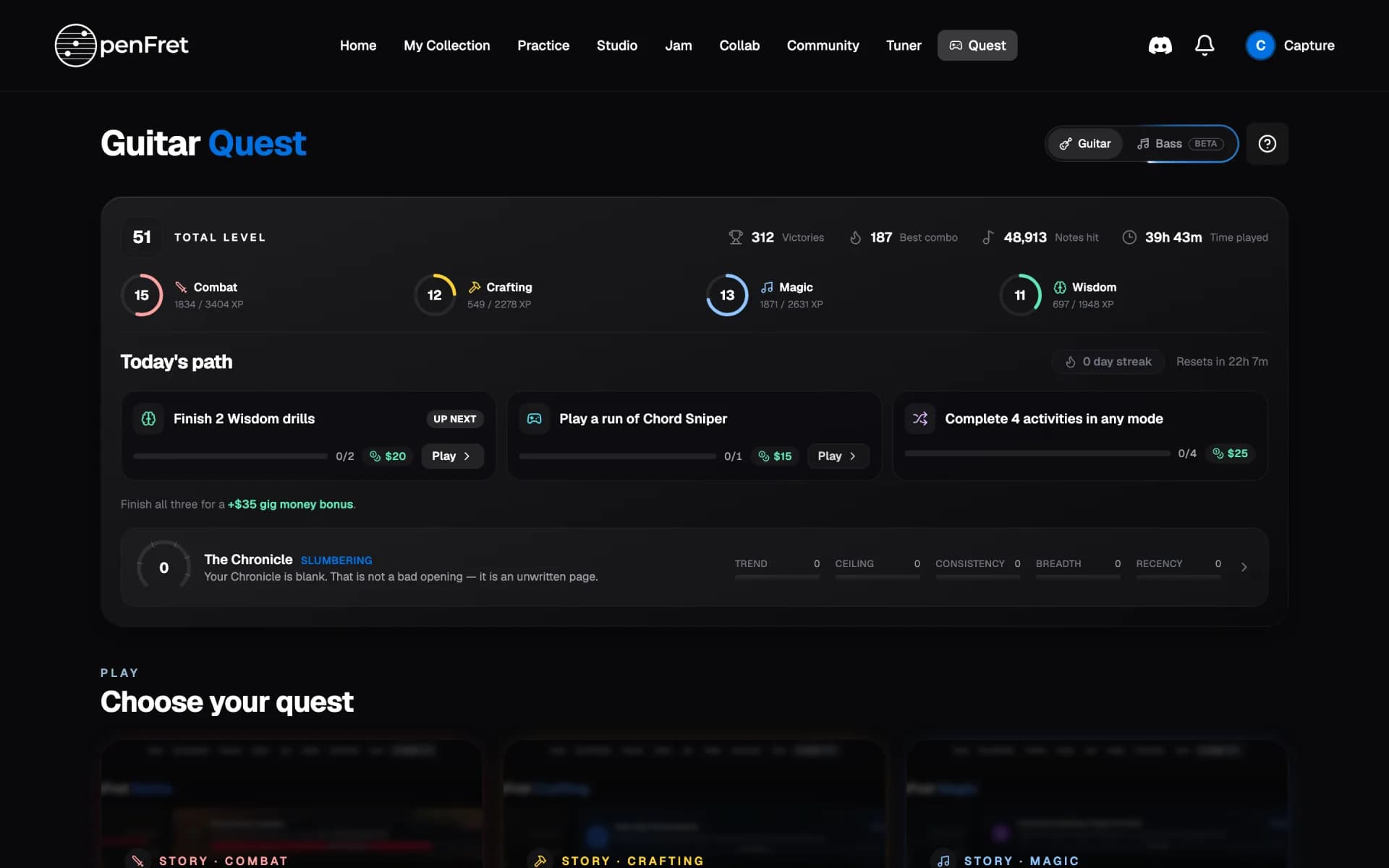
Four story modes. Nine trainers. One quest.

A whole game,
built for your guitar and bass.

Every mode runs in your browser. Every note you play is detected live. No cartridges, no controllers — just your axe and the screen.

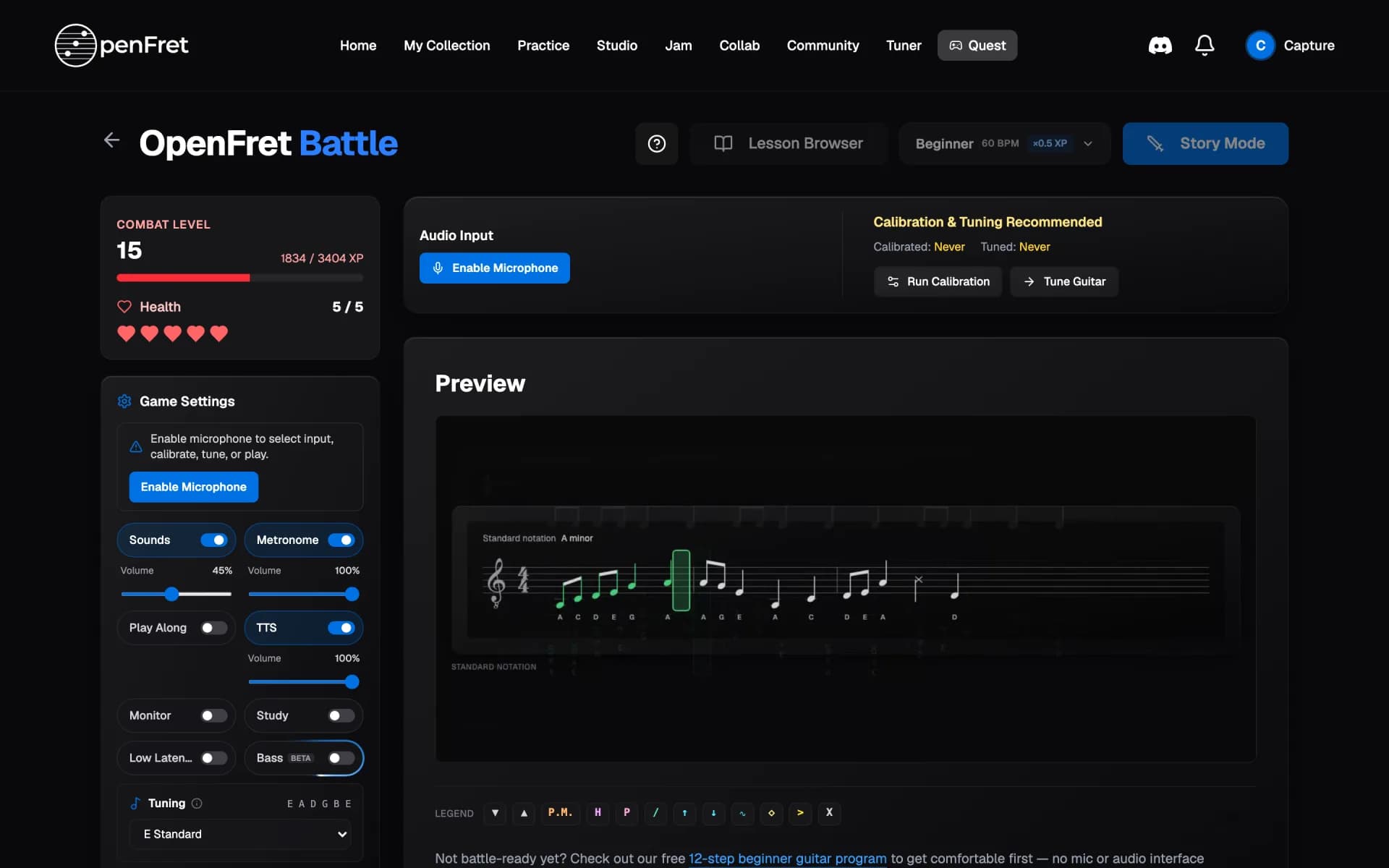
Battle

Fight monsters with real notes.

Hit the right note, deal damage. Miss, take a hit. Ten enemy types, level scaling, the whole thing.

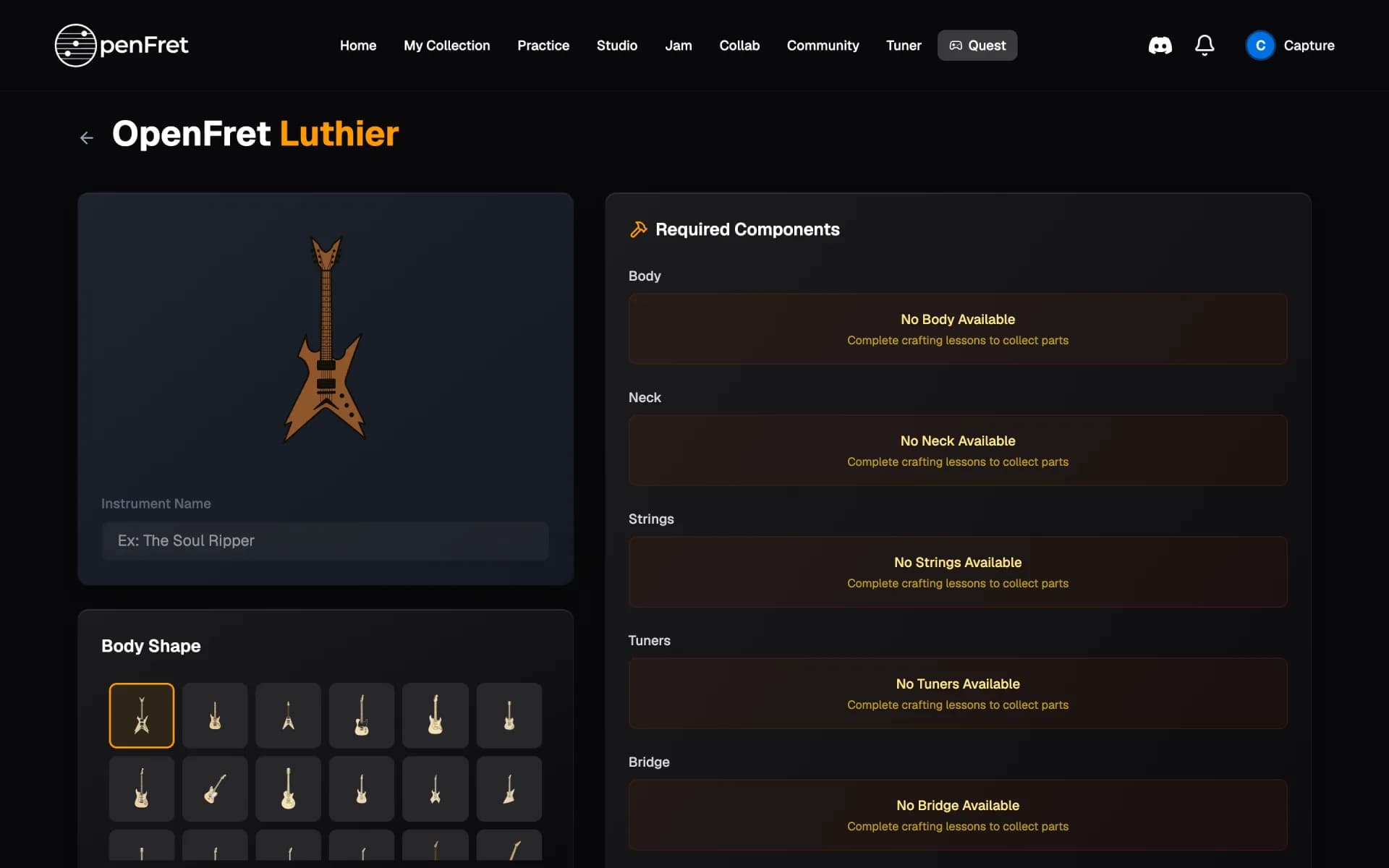
Crafting

Build your dream axe.

Loot drops parts. Common to Legendary. Eighteen body shapes, full color, every spec your choice.

Magic

Enchant your guitar.

Run scales to earn shards. Spend them on ten unique enchantments — tone, playability, inspiration.

Wisdom

Memorize the fretboard.

High-rep drills that build muscle memory for every shape, mode, and chord across the neck.

Arcade: Technique

Sweep, skip, climb.

Sweep picking, string skipping, position shifts — train the chops, then bring them into battle.

Arcade: Drills

Targeted practice that sticks.

String skipping and position shifts isolated into focused reps. Boring drills, finally fun.

Reading

Read every lesson
three ways.

Tablature

Where your fingers go. Fret numbers on six lines, with the string labels following whatever tuning you are actually in.

Standard notation

What the music is. A real engraved staff, spelled against the key instead of sharps everywhere, and written an octave above where it sounds, the way guitar music always has been.

The note highway

Neither, on purpose. Lanes, one per string, and a strike line on the left that judges the run as it arrives. For when you want to stop reading and just play.

Tab unless you ask for something else, and you can change your mind halfway through a lesson. Nobody has to learn a staff before they can start, and nobody who already reads one has to squint at fret numbers.

All three are in the free demo, with no account. Switch between them on the first lesson and see which one you read fastest.

Tunings

Stay in your tuning.
The lesson moves instead.

Guitar software normally wants you back in E standard before it will teach you anything. Guitar Quest asks which tuning you are in and rewrites the lesson to match.

Drop the whole guitar a step and the fret numbers stay exactly as written. Your hands learn the shape the lesson is teaching and the music comes out in your key, which is what you detuned for. Retune only some of the strings, the way Drop D moves one and Open G moves three, and the numbers move instead so the music still sounds the way it was written.

Some lessons cannot move honestly. An open E chord is not that shape in All Fourths, and a hammer-on forced onto a second string has stopped being a hammer-on. Those lessons play exactly as written behind a banner that names your tuning and says why, rather than turning into something else while you are reading them. Of the 7,154 pairings of a guitar lesson and a tuning, 6,957 move cleanly. That is 97.2 percent. The worst is Open A, where 458 of the 511 lessons transpose and 53 are played as authored.

Pick a tuning and the lesson comes back rewritten before the count-in. You can check that before you pay anything, in the free demo, with no account and no card.

Guitar

  • E Standard
  • E♭ Standard
  • D Standard
  • C♯ Standard
  • C Standard
  • Drop D
  • Drop C♯
  • Drop C
  • DADGAD
  • Open D
  • Open E
  • Open G
  • Open A
  • All Fourths (P4)

Bass

  • E Standard
  • E♭ Standard
  • D Standard
  • Drop D

The list stops where the microphone does. Drop B puts your bottom string at 61.74 Hz against a 60 Hz detection floor, close enough that a string which has drifted flat falls under it. A four-string C standard bass sits at 32.70 Hz, already below the 33 Hz floor on bass. Shipping either would mean your low notes timing out rather than being judged, so they are left out.

Homebrew

Bring your own music.
It never leaves your device.

Export a MusicXML file from whatever you write in and drop it on the page. Homebrew charts it for six-string guitar, works out the string and fret for every note when the export did not carry them, and then listens while you play it: a click, a count-in, a playhead, and a verdict on each note as it goes past.

Nothing is uploaded. The file is parsed where you dropped it and the chart is kept in that browser, which means there is no library to moderate, nothing to take down, and no question about who is allowed to host your transcription of somebody else's song.

MusicXML from Guitar Pro, MuseScore, Sibelius or Finale
Read in your browser, kept on your device
Ten scores included, easiest first
Tab, notation or the note highway

The trade is that a piece lives on the device that imported it, and clearing your browser data clears it. Homebrew also says what it cannot read instead of importing half a file, and a refusal names the measure and the beat it stopped on. Nothing you play there earns XP or goes on a leaderboard, because it is your file against a note count nobody reviewed.

Homebrew is part of the full game, $30 once. The free demo runs the note detection on your own guitar first, so you can find out whether it hears you before you spend anything.

Before you play

Nobody sight-reads a lesson
they have never seen.

A rhythm game hands you a chart at speed and lets you fail your way into learning it. That works for a video game and wastes your time on a guitar, so a lesson here can be read and heard before it is asked of you.

01

Read it

Study lays the whole lesson out on one static page: its own description at the top, then the bars, notes, time signature, tempo and tuning, then the thing itself engraved as tab. A button on that page sounds exactly what is on it, at the tempo you're about to be asked for.

02

Hear it

Play Along demonstrates the lesson before it asks you for it. A count-in, then one pass through your speakers against the metronome, with the playhead sweeping the tab and the notes turning green as they land. Then it says your turn and gets out of the way.

03

Play it

Count-in, and the run is yours. You have already seen the shape, heard the tempo and worked out which bar is the hard one, so the first attempt is a real attempt and not a reconnaissance lap. Both settings stay off until you switch them on.

Real-time pitch detection.
Levels, XP, loot.
Enchant. Craft. Gig.
Detection

Real-time pitch detection.

Every note. Every fret. Tracked in the browser, no plugins.

Progression

Levels, XP, loot.

Practice that feels like play. Drop rates, rare parts, the works.

Mastery

Enchant. Craft. Gig.

Spend your loot building the axe you'd dream up, then take it on stage.

The full kit

Inventory, spells, stats —
it all carries over.

Every system feeds the next. Loot from battles becomes parts at the workbench. Scales earn shards for the spellbook. Gigs pay for the shop. One loop, no dead ends.

Spellbook

Cast what you've learned.

Every enchantment you earn lives here. Apply spells to any guitar in your inventory.

Inventory

Everything you've collected.

Parts, finished builds, shards, currency — your whole loot pile, sorted and searchable.

The Chronicle

Watch yourself level up.

XP curves, lifetime achievements, and a Chronicle that runs a real trend test on your playing — so improving is a finding, not a feeling.

Luthier's Workbench

Assemble the perfect axe.

Pick a shape. Pick a finish. Drop in the parts you crafted. Make it yours.

Gigging Mode

Take it on stage.

Five gig categories. Earn money and reputation. Build a career as a solo guitarist.

Item Shop

Spend your gig money.

Buy crafting parts and magical shards with the cash you earn playing gigs.

OpenFret Arcade

Nine algorithmic trainers.
Infinite reps.

Every trainer is procedural — you'll never run out. Tunable difficulty knobs let you isolate the exact skill you want to drill.

Nine on guitar, four on bass. Sweeps, chord sniping and alternate picking are guitar problems a bassist does not have; position shifts and ear training depend on a reference tone the sampler cannot sound correctly on four strings. Better left out than shipped broken.

String Skipping Trainer

Skip between non-adjacent strings with increasing distance.

string distanceBPMnote density

Alternate Picking Speed Run

Palm-muted open strings, strict down-up picking, hopping string to string as note density climbs.

note densitystring switchingstamina

Fretboard Memory Blitz

Find notes on the fretboard from name prompts — play each on the beat.

fret spanposition shiftBPM

Scale Run Survival

Climb 3-note-per-string scale boxes across the neck — endlessly.

BPM

Chord Sniper

Snipe real open-position chords clean and on the beat.

chord poolvoicing fullnessswitch speed

Rhythm Dodge

Play muted and open string attacks in rhythmic patterns.

syncopationmute/open densityBPM

Position Shift Climber

Climb the 5 CAGED shapes, shifting up the neck.

CAGED shaperhythm tiershift distance

Ear Training Arcade

Hear a reference tone and match it, or pick a key and name the degree you just heard.

interval distancekey and modeguitar onlyBPM

Sweep Picking Path

Sweep arpeggio shapes through every key — endlessly.

BPM

New — Bass guitar

Everything above.
On four strings.

Bass is not a filter on the guitar game. It is a second track with its own character, its own lessons and its own leaderboards — every mode, start to finish, played on a real bass. Flip the switch in the header and the whole game moves over.

BattleCraftingMagicWisdomGiggingArcade
Its own character
Separate levels, XP, gold and story progress. Switching instrument never touches your guitar run.
Its own lessons
250 bass lessons, 91 of them written for bass by hand rather than converted from a guitar chart.
Its own leaderboards
Arcade runs are ranked against other bass players, not against guitarists on six strings.
Its own tunings
E standard, E flat standard, D standard and Drop D, with the lesson rewritten to match. Four of the nine arcade trainers run on bass.
Tuned for low end
Note detection reaches down to E1 at 41.2 Hz, a full octave below the guitar's lowest string.

Bass is in beta and covers the 4-string, in E Standard (E A D G) or any of the three alternate tunings above. Five-string basses are not supported yet.

What you are actually buying.

Whichever axe you own is the controller.

No plastic guitar, no dongle, no cable you have to buy from us. An acoustic and a laptop microphone is enough to start, and a bass works the same way.

Nine trainers that never run out.

The Arcade generates its drills, so the material does not end once you have memorised it. Nine on guitar, four on bass.

It tells you whether it is working.

The Chronicle runs a real trend test over your own history, so a plateau means the trend cannot be told apart from ordinary session noise, not that a line looked flat.

One price, printed on the page.

$30 once. Both instruments, every update after it, and no subscription.

Pricing

One price. The whole game.

What it costs, and how often.

Yousician
$30/mo
every month
For as long as you keep it
Rocksmith+
$19.99/mo
every month
For as long as you keep it
Guitar Quest
$30
once
Then never again
What you get

Everything in this page.
Forever.

  • Four story modes: Battle, Crafting, Magic and Wisdom
  • Nine procedural Arcade trainers on guitar and four on bass, plus Gigging and the Luthier's Workbench
  • 511 hand-written guitar lessons, and 250 on bass of which 91 are written for bass by hand rather than converted
  • Fourteen guitar tunings and four for bass, with the lesson rewritten to match
  • Every chart as tablature, standard notation or a note highway
  • Homebrew: practice your own MusicXML on six-string guitar, read on your device and never uploaded
  • A separate bass guitar track: every mode, its own character
  • The Chronicle: whether you're improving or plateauing, tested not guessed
  • Full crafting, enchanting and inventory systems
  • No level cap, and all future content updates included
  • Works with any guitar or bass, acoustic or electric
$30once

No subscription. No upsells. No ads.

30-day refund, no questions asked. Or try the free demo first.

Your guitar is enough.

So is your bass. Free demo, full game $30 one-time purchase.
No subscription, ever.

Try the demo

Questions? Answers.

OpenFret is a free guitar platform that runs entirely in your web browser. It helps guitarists track their gear, practice with real feedback, and connect with other musicians. The platform brings together guitar inventory management, practice tracking, and gamified learning into a single experience.

The main feature is Guitar Quest — an RPG game where you learn guitar by fighting monsters with real guitar notes. You play your actual guitar, and the game listens through your browser microphone, checking each note in real time. The skills you build in the game carry over directly to real playing.

OpenFret also includes Session Mode for live music collaboration, a free chromatic guitar tuner, and a community where players share their gear and practice progress. The platform is built for all skill levels — beginners can learn their first notes, while advanced players can sharpen their theory and speed.

Research published in Computers and Education(2020) found that gamified learning environments improve knowledge retention by 40% compared to traditional instruction. OpenFret's Guitar Quest applies this principle directly to guitar education.

| | Published by the OpenFret Team

Guitar Quest is an RPG game where you learn guitar by fighting monsters with real notes on your actual guitar. The game detects notes through your browser microphone in real time. Each correct note deals damage to the monster, while wrong notes cause you to take damage. Defeating monsters earns XP, gold, and loot to level up your character.

The game has four story modes. Battle mode teaches fretboard note positions. Crafting mode teaches note patterns and finger movements. Magic mode covers scales, modes, and musical patterns. Wisdom mode focuses on music theory like intervals and chord building. Around them sit nine procedural Arcade trainers, Gigging for performance challenges, the Luthier's Workbench, Homebrew for your own sheet music, and the Chronicle. A free demo is available at openfret.com/game/demo with no sign-up needed.

Most of OpenFret is completely free, and the full Guitar Quest game costs $30 as a one-time payment. The guitar inventory, practice tracking, community features, and guitar tuner cost nothing. Guitar Quest has a free demo so you can try it before buying. There is no monthly subscription. You pay once and keep access forever, including all future updates.

This pricing model is significantly different from competitors. Yousician charges about $30 per month, while Rocksmith+ charges about $19.99 per month. Both also sell a cheaper annual plan, so check their own pages before you compare a year. Guitar Quest is $30 total, once. OpenFret's one-time fee removes the cost barrier for students and hobbyists. “We believe learning guitar should not require a recurring subscription”

You need a guitar or a bass, and a device with a microphone and a web browser. Any guitar works, including acoustic and electric, and so does a 4-string bass. For electric guitars and basses, an audio interface provides the best pitch detection accuracy. For acoustic guitars, your laptop or phone microphone works fine without any additional equipment.

The supported browsers are Chrome, Firefox, Safari, and Edge. No downloads or plugins are needed. When you first open Guitar Quest, the game asks for microphone access. After that, a quick calibration step sets the right sensitivity for your signal. The whole setup takes about two minutes.

Guitar Quest teaches fretboard note positions, scales, and music theory through interactive RPG gameplay. You will learn where every note sits on the fretboard. You will practice major, minor, pentatonic, and blues scale shapes. You will also study intervals, chord building, and the circle of fifths. The game builds note recognition speed through timed challenges that simulate real performance pressure.

Each game mode focuses on a different skill area. Battle mode is best for learning note positions. Magic mode is best for scales and modes. Wisdom mode covers theory topics in depth. As you level up, the challenges get progressively harder. The game adapts to your skill level so you are always pushed but never stuck.

Research on spaced repetition shows that 10 minutes of daily practice produces better long-term retention than 70 minutes once a week. Guitar Quest's short session format is designed around this principle.

OpenFret uses your real guitar with browser-based pitch detection and requires no special hardware, downloads, or game controllers. The game runs entirely in your browser. Yousician requires a mobile or desktop app, and Rocksmith+ requires a console or PC app plus a special cable.

It also plays in your tuning: fourteen on guitar and four on bass, with the lesson itself rewritten to match. Yousician expects you back in standard. Rocksmith+ pitch-shifts the audio instead, which answers the same problem for a uniform detune but still asks you to move a string for a partial one like Drop C. It also reads a MusicXML file you bring, in your browser and without uploading it, which neither of them will do. Checked in August 2026.

Guitar Quest's RPG format makes practice feel like a video game. You fight monsters, earn XP, collect loot, and level up. OpenFret also includes gear tracking and live collaboration features that Yousician and Rocksmith do not offer.

Uses real guitar

OpenFret
Yes
Yousician
Yes
Rocksmith+
Yes

Bass guitar supported

OpenFret
Yes
Yousician
Yes
Rocksmith+
Yes

No download needed

OpenFret
Yes
Yousician
No
Rocksmith+
No

Pricing

OpenFret
Free + $30 once
Yousician
$30/mo
Rocksmith+
$19.99/mo

The lesson is rewritten for your tuning

OpenFret
14 tunings
Yousician
No
Rocksmith+
Shifts the audio

Import your own MusicXML

OpenFret
Yes, on your device
Yousician
No
Rocksmith+
No

Gear tracking

OpenFret
Yes
Yousician
No
Rocksmith+
No

As of March 2026, OpenFret is the only browser-based guitar-learning RPG that requires no app download.

Pricing based on publicly available information as of March 2026.

OpenFret is the most complete free platform for guitarists available today. It combines learning, tracking, and community in one tool.

  • Guitar Quest makes practice fun — learn fretboard notes, scales, and theory by fighting monsters with your real guitar or bass
  • All-in-one platform — inventory tracking, practice analytics, tuner, live collaboration, and community
  • No downloads or special hardware — runs in your web browser using microphone-based pitch detection
  • Bass players are included — a full bass guitar track with its own character, levels, and lessons, at no extra cost
  • Simple and fair pricing — core features are free and Guitar Quest is $30 one-time purchase

Whether you are just starting guitar, picking up a bass, or have been playing for years, OpenFret gives you the tools to practice better, stay organized, and have fun. Try the free demo at openfret.com/game/demo.

| Published by OpenFret | For questions, visit our About page or join the OpenFret Discord

Yes, Guitar Quest runs in any modern web browser on mobile phones, tablets, and computers. Since it is a web app, there is no app store download required. The game uses your device's built-in microphone to detect guitar notes.

Supported browsers include Chrome, Safari, Firefox, and Edge. For the best experience on mobile, use headphones to prevent the phone speaker from feeding back into the microphone.

Yes, OpenFret's core platform is completely free. This includes the guitar inventory tracker, practice session logger, community features, real-time collaboration, and the chromatic guitar tuner. Guitar Quest offers a free demo with no signup required. The full game is a $30 one-time purchase with no monthly subscription.

Yes. Bass guitar is supported across every mode of Guitar Quest, as its own learning track rather than a setting. Flip the instrument switch and Battle, Crafting, Magic, Wisdom, Gigging, and the Arcade move to a 4-string bass. Note detection retunes to the bass range, the tab charts redraw on four strings, and the lesson catalog is remapped to bass fingerings.

Your bass is a separate character with its own levels, XP, gold, story progress, and Arcade leaderboards. Switching instrument never touches your guitar run, so you can carry both at once and go back and forth. Bass is included in the same $30 one-time purchase. There is no separate bass purchase.

Bass support is in beta and covers the 4-string in standard tuning (E A D G). Five-string basses and alternate tunings are not supported yet. Read more about learning bass with OpenFret.

Yes, OpenFret works with acoustic, electric, classical, and bass guitars. For acoustic guitars, your device's built-in microphone picks up the sound directly. No additional equipment is needed.

For electric guitars, plugging into an audio interface connected to your computer provides the cleanest signal for pitch detection. The built-in microphone also works if you play through an amplifier.

Yes, OpenFret includes a free guitar practice tracker. You can log practice sessions with notes about what you worked on, track songs you are learning, view statistics by guitar and time period, and build daily practice streaks.

Research shows that musicians who track their practice sessions improve significantly faster than those who do not. Start tracking your practice at openfret.com/practice.

Still deciding?